
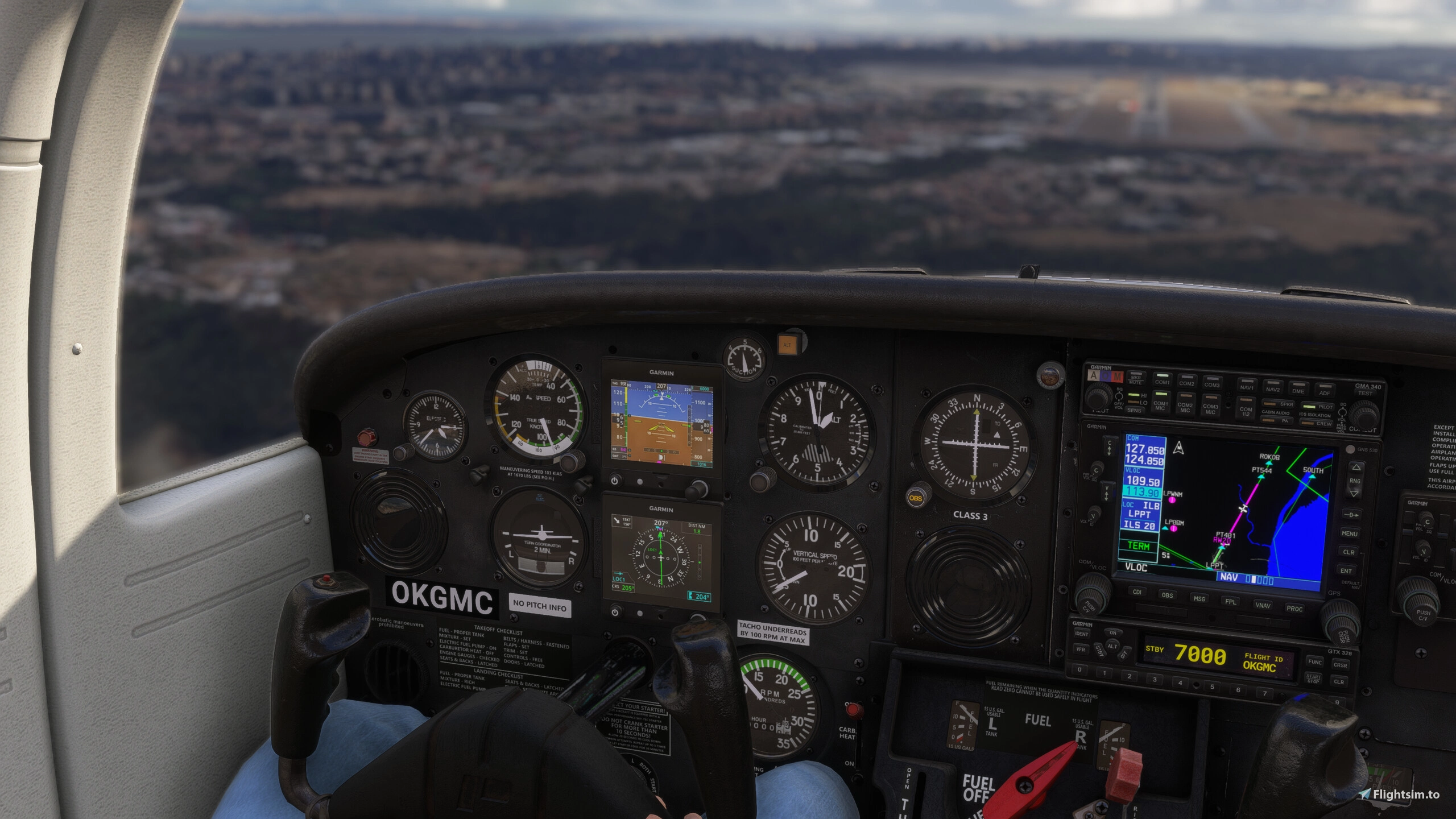
Description
This addon is based on the original addon by tb110188 and Sal1800: Enhanced Garmin G5 Attachment.
I started this project while training for my instrument rating to familiarize myself with the avionics used in the plane I fly in real life. As the original plugin by tb110188 and Sal1800 lacked many IFR-essential features and differed visually in some ways, I first modified the original source files, but eventually decided to completely rewrite it natively for the MSFS 2024 using the new SDK.
Installation
As a community addon, place the addon folder into your MSFS Community folder, or use a tool like MSFS Addons Linker to manage your addons.
After installation, you should see the C172 (and other supported aircrafts) with enhanced G5 avionics in the variants configuration or the separate aircrafts, for the planes which don't have native MSFS 2024 support.
Supported aircrafts
- Asobo Cessna 172SP
2 new presets for the classic C172, with Analog gauges combined with G5 and IFD variant with G5.
- Asobo Cessna 152
A new preset for the C152, replacing the attitude indicator and directional gyro with G5.
- Microsoft Cessna 185F Skywagon
A new preset for the C185F, replacing the attitude indicator and heading compass with G5 PFD and MFD.
- Microsoft Piper PA28-236 Dakota
A new preset for the Dakota, replacing the attitude indicator and HSI with G5.
- Just Flight's PA28 Warrior II (version 0.4.4)
A new aircraft type inheriting from JF PA28. Tested in combination with GTN units.
- Just Flight's PA38 Tomahawk (version 0.1.5)
A new aircraft type inheriting from JF PA38. Tested in combination with GTN units.
- Carenado's C182 RG II (version 1.0.2)
A new aircraft type inheriting from the Carenado C182RG, replacing the AI and HSI.
The issue with custom variants for third-party aircrafts, such as PA28/38 is that any update to the base aircraft can break the G5 unit. Due to that, it's better to request support for custom variants directly from manufacturer of the aircraft. Once the addon is installed, for the third-party aircrafts (PA28, PA38 and C182 RG II), there will be a new aircraft type based on original plane available list. For the classic C172, new variants are available in the aircraft configuration.
PFD
I tried to make the PFD features and visuals as close to the real G5 (the one I use in real life) as possible, even though there are some compromises, e.g., due to the different screen aspect ratios. As I fly in Europe, the baro uses hPa as a default, but it's configurable via PFD setup page.
A few things that were added/redesigned:
- Reference speed badges (Vy, Vx, Vg, Vr)
- Speed tape design
- Turn & Slip indicator including Rate-1 turn indications on attitude indicator
- Ball, CDI and VDI visual
- Vertical speed indicator
- QNH in hPa and inHg (via PFD setup page)
- Horizontal compass displays varios info, such as ground track or nav course
- AP info box which displays when AP is active (or any annunciation is available)
- Flight director, for aircrafts which support it. As of now only MSFS 2024 native C172SP supports it.
- OAT box below the ground speed, in °C or °F (toggled via Setup → OAT Units)
- TAS box at the top of the airspeed tape (toggled via Setup → TAS)
For AP there are currently only basic modes available and none FD, because none of the aircraft has more complex AP (such as GFC500) available, which would have this functionality.
MFD
The MFD tries to mimic the MFD I use in real life as well; however there are more configuration options and navigation modes, which depend on avionics integration. For example, as the C172 model from Asobo lacks a standalone DME, I decided to keep the HSI waypoint distance visible for VLOC mode as well, even though normally it should not be displayed.
A few things that were added/redesigned:
- Bearing pointers and their setup in the menu
- Menu, submenus and dropdowns, e.g. to select bearing pointer source
- OBS course selector
- Heading vs track indication
- VDI
- DTK/CRS modes in lower left panel
- NAV mode and phase indications
- GPSS mode, which simulates the GPS steering by adjusting the heading
- Wind box in the top left corner, showing wind direction arrow, speed and direction (toggled via Setup → Wind). The wind data is shown only when airborne with TAS of at least 30 kt, otherwise
NO WIND DATAis displayed.
Setup Page Differences
On the real G5, the OAT, TAS and wind displays are enabled in the installer configuration mode, not in the pilot-accessible setup menu. As the simulated unit has no configuration mode, these options were added to the PFD and MFD setup pages instead.
For more information and any requests, please visit my project repository at https://github.com/johnygomez/msfs-garmin-g5-ifr and give it a star if you like it :)
In case you want to report bugs and problems, or OTOH request support for new aircrafts and add features, please open the issue in the Github repository.
Known Issues
- The exterior view of our custom Carenado C182 RG II aircraft, the cockpit texture is not loaded properly, as incompatibility with MSFS 2024 LOD logic breaks the chain. As a result, the interior is visible only when zoomed in. Any modifications to LOD mechanism/minSizes are ignored.
- The IFD and legacy MSFS 2020 GPS integrations are a little buggy. They probably don't write the new MSFS 2024 SimVars and as a result, it's not possible to resolve the GPS mode (CDI scale) properly. As a result, the MFD says GPS is in e.g. ENR route, when TERM should already be there. To avoid the issue, I recommend using PMS and modern MSFS 2024 GPS variants.
- On Just Flight's PA28 Warrior II, the aircraft doesn't allow adding custom electrical circuits, so both G5 units have to share one of its existing ones. As a result, pressing the power knob on either unit turns both G5s on or off at the same time.
Garmin G5 IFR
This add-on provides a native MSFS 2024 implementation of the Garmin G5 avionics suite, tailored for IFR training and usage. It features an enhanced PFD with realistic reference speeds, turn indicators, and a redesigned speed tape. The MFD includes customizable bearing pointers, advanced menu options, and improved navigation display elements. Designed for the C172, it aims to closely replicate real-world Garmin G5 functionality.


User Reviews
12 reviews
Version History
This feature release brings several displays from the real G5: an OAT box, a TAS box, and a wind indicator. It also adds reference speeds on the airspeed tape while on the ground and a second variant of the PA28-236 Dakota with fairings, as requested multiple times. The heading/course knob acceleration has been reduced for easier manipulation. What's Changed: feat: ✨ Introduce new variant of the PA28-236 Dakota with wheel fairings feat: ✨ Add OAT box below the ground speed on the PFD, in °C or °F (toggled via Setup → OAT Units) feat: ✨ Add TAS box at the top of the airspeed tape (toggled via Setup → TAS) feat: ✨ Add wind direction box to the top left corner of the MFD (toggled via Setup → Wind) feat: ✨ Display reference speeds at the bottom of the airspeed tape when below 20 kt on ground feat: ✨ The airspeed tape no longer shows values below 20 kt to mirror real G5. feat: ✨ Decrease knob acceleration, so it's easier to set the exact heading/course fix: 🐛 The CDI on the PFD didn't reflect the required RNAV precision (e.g. it stayed at 1 NM on LPV approaches instead of 0.3 NM) Known Issues: On the real G5, the OAT, TAS and wind displays are enabled in the installer configuration mode. The simulated unit has no configuration mode, so these options are on the PFD and MFD setup pages instead.
Log in to join the discussion
Log InComments(94)
about 13 hours ago
about 8 hours ago
about 17 hours ago
about 8 hours ago
3 days ago
3 days ago
10 days ago
9 days ago
12 days ago
12 days ago
12 days ago
12 days ago
12 days ago
18 days ago
18 days ago
22 days ago
21 days ago
21 days ago
25 days ago
22 days ago