
Description
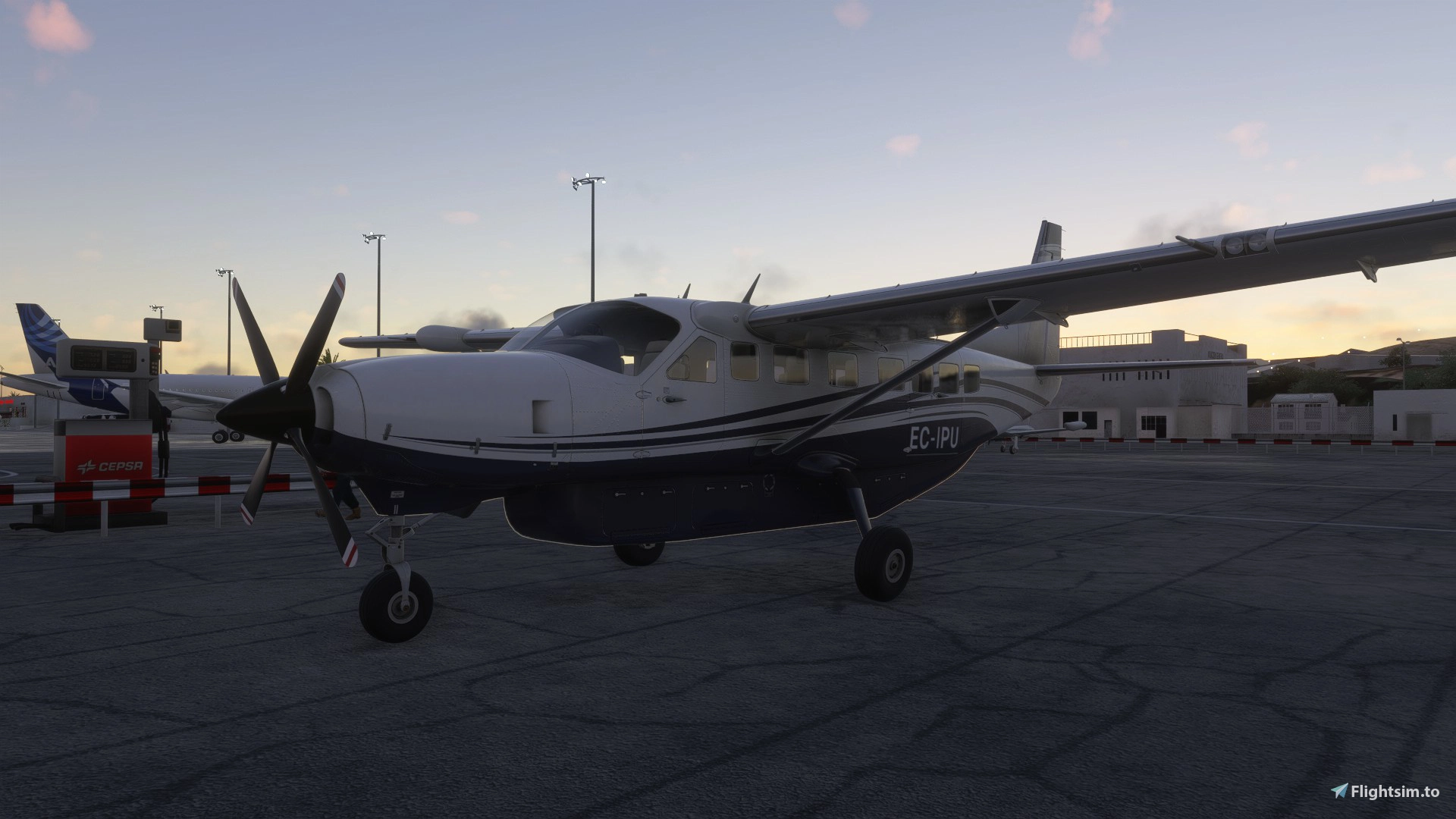
Fly the new classic Cessna 208B Grand Caravan with modern G1000 avionics!
Designed to bring the classic new Aircraft Cessna 208B Grand Caravan (not the EX) with the G1000 back into your hangar, completely upgraded and good-fidelity flight dynamics.
This mod creates a distinct, separate aircraft entry.
Expand Your Fleet in MSFS2024!
This mod is compatible with MSFS2024:
The NEW 208B Grand Caravan with G1000: Fly the classic variant equipped with the modern G1000 glass cockpit.
This allows you to choose exactly which variant fits your mission profile for the day!
Key Features
- Aircraft: It appears as a separate aircraft in your selection menu.
- Cross-Gen Ready: Perfectly optimized to work in MSFS2024.
- The liveries of the Cessna 208B are compatibles.
Installation Instructions
- Download the zip archive.
- Extract the folder directly into your Community folder (MSFS2024).
- Select the Cessna 208B Grand Caravan (G1000)
in your aircraft selection screen an have a nice flight!!
New aircraft Cessna 208B Grand Caravan (G1000) - (MSFS2024)
This add-on introduces the New Aicraft Cessna 208B Grand Caravan (Not the EX) equipped with modern G1000 avionics as a separate aircraft entry in Microsoft Flight Simulator 2024. Featuring upgraded flight dynamics and compatibility with existing liveries, the mod allows users to fly the classic Grand Caravan variant with a glass cockpit. It is optimized for MSFS2024 and integrates seamlessly within the aircraft selection menu.


User Reviews
1 reviews
Version History
No version history available.
Related

Boeing 737 MAX 8200 Ryanair / EI-IGE (MSFS2024 / Asobo Base)
This add-on provides a detailed Ryanair Boeing 737 MAX 8200 livery for the Asobo 737 MAX in Microsoft Flight Simulator 2024. It features authentic branding, accurate registration placement, and high-resolution 4K textures. Native compatibility with MSFS2024 ensures optimized visual fidelity, including tailored metallic and gloss reflections. The livery reflects specific details and configurations of the real Ryanair EI-IGE aircraft.
by Tobaito
Transavia (France) Airbus A320-252 neo (F-HXSK) — FlyByWire A32NX [Semi-Requested]
This add-on features a detailed Transavia France livery for the Airbus A320-252 neo, accurately representing registration F-HXSK. The livery is designed for the FlyByWire A32NX and includes high-resolution textures, precise color matching, and authentic decals. It is compatible with both Microsoft Flight Simulator 2020 and 2024. The textures and markings closely match real-world references for realistic in-sim immersion.
by Tobaito

Inibuilds Airbus A330-200 Iberia / EC-MKJ (4K & Custom Cabin | EIS1)
This add-on features a highly detailed recreation of the Iberia Airbus A330-200 with registration EC-MKJ for Microsoft Flight Simulator. It includes crisp 4K textures, true-to-life Iberia branding, and a meticulously modeled custom passenger cabin. The cockpit is configured with the classic EIS1 avionics layout, replicating the traditional Airbus systems. Custom gloss and metallic effects enhance the overall realism of the aircraft exterior.
by Tobaito
Transavia (France) Airbus A320-252 neo (F-GNEO) — FlyByWire A32NX
This add-on provides a detailed Transavia France livery for the FlyByWire A32NX Airbus A320 NEO, featuring the registration F-GNEO. The livery includes accurate colors, custom decals, and high-resolution textures matched to real-world references. It is compatible with both Microsoft Flight Simulator 2020 and 2024. Installation is completed by placing the extracted folder into the Community folder of your simulator.
by Tobaito
Log in to join the discussion
Log InComments23
😊
Visual Identification: Original short fuselage, 3-blade propeller (variable-pitch McCauley), and a completely clean underside (no external cargo pod).
Certification Year: October 1984.
Powerplant: 600 shp Pratt & Whitney Canada PT6A-114.
Avionics: Classic analog cockpit ("steam gauges" or "six-pack" instrumentation).
Technical Details: The pioneer of the family (internal factory code: 208). With a length of 11.46 meters, it was originally designed as a rugged transport aircraft capable of operating on unpaved runways (STOL), with a capacity for up to 9 passengers or a basic cargo configuration.
2. Cessna 208 Caravan Super Cargomaster
Visual Identification: Original short fuselage, 3-blade propeller; passenger windows removed, painted over, or covered with blank aluminum panels along the sides.
Launch Year: 1985.
Powerplant: 600 shp Pratt & Whitney Canada PT6A-114.
Avionics: Conventional analog systems, optimized for single-pilot instrument flight (IFR).
Technical Details: Developed according to specific requirements from FedEx (the official version for FedEx is designated as the 208A). The interior was delivered completely empty from the factory, featuring a flat, reinforced cargo floor equipped with tie-down nets and safety barriers behind the crew seats. The rear left-side passenger door was removed to reduce weight and complexity. 3. Cessna 208 Grand Caravan
Visual Identification: Elongated fuselage, 3-blade propeller, and the characteristic external cargo pod mounted beneath the belly.
Year of Launch: Certified in late 1989 (deliveries began in 1990).
Powerplant: Initially introduced with the upgraded 675 shp PT6A-114A engine to compensate for the increase in weight.
Avionics: Analog.
Technical Details: The first major structural evolution in the series: Cessna extended the fuselage by 1.22 meters (4 feet) using two extension sections (forward and aft), resulting in a total length of 12.67 meters (41.6 feet). This increased regional commercial transport capacity to a maximum of 14 passengers and introduced a composite cargo pod as standard equipment, ensuring that cabin space for luggage would not be compromised.
4. Cessna 208 Grand Caravan Super Cargomaster
Visual Identification: Elongated fuselage, 3-blade propeller, no passenger windows (either painted over or omitted from the sides), and equipped with an external cargo pod beneath the belly.
Year of Launch: Early 1990s (derived from the base 208 Grand Caravan fuselage).
Powerplant: 675 shp Pratt & Whitney Canada PT6A-114A.
Avionics: Analog.
Technical Details: This variant optimized logistics volume capacity by combining the long fuselage of the 208 series with an external cargo pod. Like the shorter model, it removed all passenger comfort features and incorporated a two-section rear cargo door—a "mini" cargo door—which facilitated the loading of pallets and express freight. 5. Cessna 208B Grand Caravan (Mechanical Evolution)
Visual Identification: Elongated fuselage, presence of an under-fuselage cargo pod, and a major external change: the introduction of a new 4-blade aluminum alloy propeller (Hartzell or McCauley).
Launch Year: Late 1990s / early 2000s.
Powerplant: 675 shp Pratt & Whitney Canada PT6A-114A (standardized).
Avionics: Analog, with the option for early integrated GPS navigation systems (analog BendixKing/Garmin units).
Technical Details: The transition to a 4-blade propeller significantly improved the aircraft's acoustic signature, reducing noise levels both inside the cabin and in the vicinity of airports. Furthermore, the 4-blade design optimized thrust response on short runways and increased ground clearance for the propeller during operations on uneven terrain.
6. Cessna 208B Grand Caravan (Modern Avionics)
Visual Identification: Same exterior as the previous phase (elongated fuselage, 4-blade propeller, cargo pod installed), but featuring a fully integrated "glass cockpit" with flat-panel displays.
Launch Year: 2008 (factory standardization) — currently, it is also possible to retrofit analog cockpits to digital systems using the Garmin G1000.
Powerplant: 675 shp Pratt & Whitney Canada PT6A-114A.
Avionics: Garmin G1000 digital suite (featuring two primary PFD/MFD displays).
Technical Details: This marks the end of the traditional analog cockpit in Cessna’s production line. The Garmin G1000 integrated system centralized flight data, navigation, engine parameters (EIS), and moving maps. This upgrade included the Garmin GFC 700 three-axis digital autopilot as standard equipment, enhancing operational safety.
With your mod everything works again. Happy Bunny!
😊