
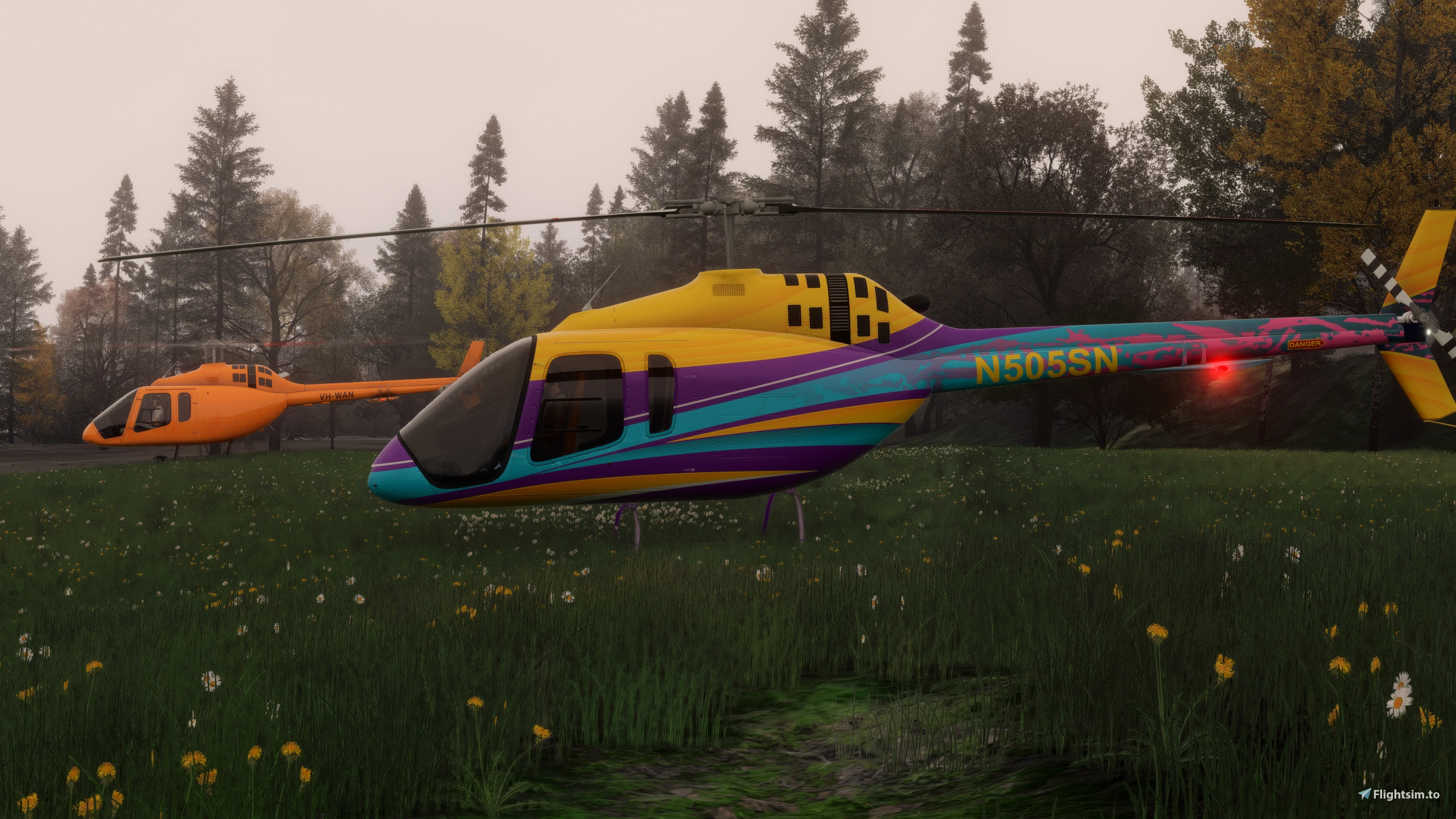
Description
The freeware Bell 505 that flies by Bell's own book. It won't forgive a sloppy descent. It burns the fuel Bell says it burns.
You want a helicopter where the numbers mean something. Where the torque you pull is the torque Bell says you need. Where the engine runs out of breath at altitude exactly where the chart says it will. Where a careless descent drops you into your own downwash and only good flying gets you out.
This is that helicopter. The jXt Bell 505, stripped to the rotor hub and rebuilt from Bell's own manuals and performance charts: flight model, engine, FADEC, systems, cockpit, and now the air inside the cabin.
One developer. A stack of RFM pages. Two hairs left. FREEWARE. BETA. Payware ambition. One download, one folder: the aircraft, both skid variants and the B505 Config tablet.
🔢 Don't take my word for it
Flown against the book (cruise, hover, engine and fuel measured on the 1.0.5 test builds, the 1.0.6 re-flight is coming; rotor start and rotor response measured on 1.0.6):
- Cruise: in a logged 40-minute test flight, 38 stable segments against Bell's Specification Book cruise charts: torque +1.0 % over the chart at 110 kt and +0.9 % at 120 kt; in level flight at 116–117 kt, within half a percent.
- Hover: in ground effect, 55–57 % torque at 3,510 lb against 57.5 % (±2.3) derived from Bell's hover-ceiling charts. Out of ground effect, 59.0 % at 2,785 lb against 59.4 %.
- Engine: Q 98 % → Ng 101.3 %: the turbine's takeoff limit, exactly where the book puts it. Q 100 % with Ng 99 % at 1,000 ft and 20 °C: the transmission limit comes first and the engine keeps its margin.
- Fuel: the fuel map follows Bell's Specification Book to ±0.6 lb/h, and a recorded flight landed within about 5 lb/h of the twelve cruise charts.
- Rotor start: 63 % Nr in 39 s against 40.1 s in a real Bell 505 start (two starts, 38.8 and 39.0 s); IDLE → FLY in 13–15 s.
- Rotor response: NASA's teetering-rotor model (Talbot, Tinling, Decker & Chen, TM-84281) works its example on an AH-1G Cobra: 8,000 lb, 2,700 / 12,800 slug·ft² in roll and pitch, hub 6.6 ft above the centre of gravity. I ran the same method with the 505's numbers: 2,769 lb, 1,025 / 3,960 slug·ft², hub 4.1 ft, 9° of disc tilt, the stick reaching the stop in one second. It predicts 2.2 s to roll to 90° and 3.4 s to pitch to 90° from the hover at 1 g. Stopwatch in the sim: a little over 2 s and 3.4 s.
Built from the book:
- Limits: 100 % torque = 442.5 ft·lb; torque 90 / 100 / 105 %, Ng 99.8 / 101.2 / 103.6 %, MGT 817 / 853 / 882 °C, with the 5-minute takeoff timer. Governor at 63 % in IDLE and 104 % in FLY.
- Power assurance: Bell's chart, 781 points, extended past its printed edge by a turbine law that reproduces it to 0.34 % Ng RMS and the RFM hover ceilings to 0.9 % torque RMS.
- Ground effect: the in-ground-effect factor at 3 ft skid height (0.845), taken from 35 pairs of Bell's IGE and OGE hover ceilings.
- Cruise: the twelve Specification Book cruise charts (sea level to 10,000 ft, ISA and ISA+20, five weights), digitized from the vector PDF.
- Bleed air: 35–42 hp, from the RFM.
- Weight and balance: the 14 loading stations and the CG envelope of the RFM.
- Oil: the transmission thermostat (200 °F → 215–225 °F) and its 53–59 PSI regulator from the maintenance manual; engine oil below 110 °C in normal operation.
🆕 New in 1.0.6
- A cabin that fights back. Bleed-air heat that costs 35–42 hp, fog on every window, DEFOG, a fresh-air vent and doors that change the air.
- A FADEC with a spine. It limits by torque, Ng or MGT, whichever comes first, saves a drooping rotor with one short transient, and leaves the last call to you below 97 % Nr.
- Gauges past the edge of the chart. Ng and MGT keep telling the truth when you fly colder, hotter or higher than the printed chart.
- Oil that behaves. One radiator with the engine and transmission circuits inside, a blower on the tail rotor drive shaft plus ram air in forward flight, thermostatic bypass valves on both sides that hold the oil at operating temperature, and cold-oil pressure you can see.
- Power counted at the real rotor speed. In FLY the drive turns at 104 %, and the flight dynamics and the bleed cost now use it.
- Lift only where the book says. The flight-dynamics module adds power where Bell's charts say the sim is short of it, and nowhere else: it fades out above 1.05 g and is gone by 1.30 g, it stays off inverted or with the disc on its side, and it follows rotor RPM squared. Pull hard, roll it over or let the rotor droop, and nothing holds you up but the rotor itself. In a logged test: zero pounds of help above 1.06 g and zero through 21 seconds inverted. It also substracts the excess of lift on the msfs model where needed, for example on a high G manoeuvre.
- Nine degrees of cyclic. Full stick commands the 9 degrees of blade pitch in the maintenance manual, with unity cyclic and pedal gains and a travel-rate limit that slows a slammed stick, not a correction. The rotor's gyroscopic coupling to the airframe is scaled down to what a teetering head transmits, and the result is checked against NASA's teetering-rotor method, re-derived from its AH-1G Cobra example with the 505's weight, inertias and hub height: 2.2 s predicted to roll to 90° and 3.4 s to pitch to 90° from the hover; a little over 2 s and 3.4 s on the stopwatch.
- Flat pitch that is flat. Collective full down gives −1.88° of blade pitch: no negative thrust at the bottom of the lever. Autorotation flown at 1,800–2,200 fpm at 60 kt with Nr held at 104 %.
- Flight dynamics that remembers. It corrects the sim's rotor against Bell's charts in steady 1 g flight only, and keeps what it learned from one flight to the next.
- Your passengers stay aboard. The tablet puts them back after a restart.
🌀 Fly it like a 505, or it bites
- Blades that stall. The blades stall where the real airfoil stalls: the polar comes from published airfoil data, stall included. Pull too hard and the lift goes.
- Two blades, flown like two blades. Rolls build instead of snapping. Unload the rotor and it stops answering you; that quiet is a warning. Hold the cyclic against the stops and you are into mast bumping: it costs you rotor RPM.
- The tail rotor can quit. Heavy, hot, high, wind from the wrong side, and it lets go. Ease off the pedal and bring it back gently.
- Skids that flex. They bend with ground contact, so a firm landing or a slope looks and feels like one.
- The ring is waiting. No manufacturer publishes a VRS chart: the ring sits where rotor physics puts it. This one follows Wayne Johnson's NASA vortex-ring-state model, scaled live by the 505's 18.5 ft rotor, its weight and the air density. Heavier or higher, the ring moves to faster descents. More collective digs you deeper. Cyclic is the way out. The sim's VRS protection helper is off.
📖 Torque that answers to Bell
MSFS still does the rotor physics. A WASM flight-dynamics module makes them answer to Bell, every frame.
- Hover and cruise, held to the charts. In and out of ground effect, at any pressure altitude, temperature and weight. The torque gauge stops lying.
- Ground effect, by Cheeseman–Bennett. Near the ground the air carries you. Climb out of it and you pay.
- Translational lift, the way the real one feels it. MSFS's rotor doesn't unload physically when it finds clean air. At least I still don´t know how to make it work on the newest msfs flight model, it only unloads something like a 5-6% of torque at best, the legacy fm has some tuning parameters for the inflow tuning. So the unloading is computed with proper rotor aerodynamics (weight, air density and airspeed) and applied by moving the knee of the collective. Your lever stays exactly where you put it: hold it, gather speed and the torque falls, as in the real aircraft. Want the climb back? Pull more, like a real pilot.
- Nothing is free. Climbs cost power and descents give it back. Updrafts and downdrafts count. Every g in a turn costs airspeed. Dropping the nose buys you no lift.
🔥 A FADEC with a spine
A custom FADEC supervisor runs the Arrius 2R from START to shutdown, built on Bell's power-assurance charts and real startup footage.
- Gauges from Bell's charts. Ng, MGT and fuel flow come from Bell's charts, not from the default engine. Past the printed edge (cold, hot, high), a corrected-parameter turbine law takes over, so the gauges keep telling the truth where the paper ends.
- Limits that hold. Torque, Ng or MGT, whichever comes first, at max continuous or 5-minute takeoff power. Ng touches 101.2 % exactly where the power runs out. Down low, the transmission limit arrives first and the turbine keeps its margin.
- Your call when it counts. If the rotor droops, the FADEC digs it out with one short transient. If Nr falls below 97 % and you keep pulling, it gives you the power anyway, and the CAS calls out the exceedance. Better an exceedance than a crater.
- PSI as in the manual: 3 at idle, 5 at flat pitch, 10 at max continuous.
- Oil that behaves. Engine and transmission oil run through two circuits inside one radiator, cooled by a blower driven by the tail rotor drive shaft: it turns whenever the rotor does, and in forward flight ram air adds to it. Each side has its thermostatic bypass valve, so cold oil skips the cooler until it warms (the transmission's starts at 200 °F / 93.3 °C, per Bell's documents), and the hot transmission oil takes some cooling away from the engine side when both run through the radiator. Cold oil shows high pressure until it warms.
- It remembers. The engine keeps its heat after shutdown. Right-click and hold ENGINE to dry-crank it. ENGINE and the manual fuel shutoff are separate valves. Every switch you flip draws from the electrical system.
Tip: put IDLE/FLY on your controller. Wing fold (off) = IDLE, Wing fold (on) = FLY, or Toggle wing fold.
❄️ A cabin that fights back
Take off at minus eighteen and watch the windshield grey over.
- Heat costs horsepower. Pull the new BLEED AIR control, modeled where the real one sits. Heat costs 35–42 hp, as in the RFM: same torque, higher Ng, MGT and fuel flow.
- Every window fogs on its own. The windshield and the four door windows fog independently, each against the temperature of its own glass, and airspeed chills the glass. Fog builds and clears gradually, inside and out.
- DEFOG, VENT, doors. DEFOG clears the windshield. The fresh-air vent dries every window and cools the cabin. Open a door and the cabin air swaps with the outside. In deep cold your own breath frosts the glass until the heater wins.
- Too much heat is a thing. In mild weather the heater will cook you. Balance it with the vent.
🧭 A Bell-style G1000H
Built on the MSFS 2024 Working Title G1000v2, with Bell-style displays on top. Working Title still flies the navigation, flight planning and maps.
- Helicopter airspeed cues and dynamic Vne.
- A slip/skid ball that actually moves, driven by air-relative lateral motion.
- Dual NP/NR tach, PSI and dedicated engine pages.
- Torque, Ng, MGT, oil and fuel, with fuel flow in pounds per hour.
- Power Assurance Check from Bell's charts, extended past their printed edge. Bleed air OFF, as the RFM requires.
- Weight-and-balance planning that agrees with the tablet and the aircraft.
- HTAWS, trip tools and system pages. (WIP)
- Optional Navigraph charts through its G1000 package.
📱 Load it, balance it, save it
The B505 Config tablet sets up passengers, baggage, fuel and equipment, shows the weight and CG, warns you before you do something stupid, and applies the load. Pounds or kilograms.
Config Saving works per livery and variant, autosaved every 10 seconds: fuel, loads, equipment and passengers come back after a restart. The sim likes to reset your passengers while the aircraft loads; the tablet now waits and puts them back.
🧪 Prove me wrong
Think you can break it? Fly it heavy, hot, high, in weather. Bring numbers: weight, fuel, altitude, OAT, IAS, torque and Ng, plus MGT and the flight condition when relevant. "It feels weird" starts the conversation; numbers finish it.
⚠️ Straight talk
It's a beta, and here is what isn't done yet: maintenance, and the HTAWS, trip and system pages. At the same torque, MGT still reads a few degrees high in forward flight; that one is next. Push past VNE in a dive and it doesn't punish you enough yet: retreating-blade stall and advancing-tip effects are coming. Inverted with the collective down, the rotor brakes the fall the way it would in an autorotation. Without g the rotor loses its authority, but the sim still lets you roll and loop it: mast bumping is not modelled yet. Realism model: fly it with the simulator's helicopter assistances off, and on a spring-centred joystick cut the cyclic sensitivity curve by about 30 %. You'll hear it from me first.
It's free. Download it, fly it by the book, and find out how good you really are.
📦 Installation
- Close Microsoft Flight Simulator 2024.
- Coming from 1.0.5? Delete the old
jxt-mzapata-bell505folder first. Coming from 1.0.4 or older? Deletejxtsimulations-aircraft-bell505andjxt-b505-efb-config; from the experimental build, deletejxt-mzapata-bell505-experimental. They can't be installed side by side. - Extract the
jxt-mzapata-bell505folder from the ZIP into your Community folder.
One folder. Your jXt Bell 505 liveries keep working as they are. By installing it you accept the EULA included in the package (EULA.txt). If a livery's saved load doesn't come back after updating, set it up once and save it in the tablet (CONFIG SAVING).
⭐ Credits
This helicopter stands on other people's work. Here is who made it possible.
The aircraft jXt Simulations / thommoj — The original freeware Bell 505, and the permission to take it apart and rebuild it.
The book Every number in the flight model, the engine and the systems is checked against these.
- Bell Textron — Bell 505 Rotorcraft Flight Manual, Maintenance Manual, Product Information Guide (student guide) and the Specification Book performance charts.
- Safran Helicopter Engines — Arrius 2R documentation, with the EASA and FAA type certificate data sheets.
- Red Aviation — the Bell 505 startup video the rotor start is timed against.
- Bell 206L3/L4 documentation — related-family references for rotor lineage and geometry.
The research behind the flight dynamics MSFS runs the rotor. These studies decide what it has to answer to.
- Rotor inflow and forward flight — Hermann Glauert's momentum theory; Heffley & Mnich, Minimum-Complexity Helicopter Simulation Math Model, NASA CR-177476 (1988); Talbot, Tinling, Decker & Chen, A Mathematical Model of a Single Main Rotor Helicopter for Piloted Simulation, NASA TM-84281 (1982); Wayne Johnson, NDARC — NASA Design and Analysis of Rotorcraft (2010).
- Ground effect — Cheeseman & Bennett, The Effect of the Ground on a Helicopter Rotor in Forward Flight, ARC R&M 3021 (1955).
- Vortex ring state — Wayne Johnson, Model for Vortex Ring State Influence on Rotorcraft Flight Dynamics, AHS specialists' meeting, San Francisco (2004), NASA Ames.
- Blades and airfoils — Critzos, Heyson & Boswinkle, Aerodynamic Characteristics of NACA 0012 Airfoil Section at Angles of Attack from 0° to 180°, NACA TN 3361 (1955); Ludwig Prandtl's tip-loss model in the blade-element calculations.
- Flight dynamics and handling — Gareth Padfield, Helicopter Flight Dynamics; Gordon Leishman, Principles of Helicopter Aerodynamics; Ray Prouty, Helicopter Performance, Stability, and Control.
The simulator and the cockpit The platform everything above runs on.
- Microsoft & Asobo — Microsoft Flight Simulator 2024.
- Working Title — the G1000 avionics foundation under the Bell-style cockpit.
- Navigraph — optional charts through its G1000 package.
The people The ones who kept this going.
- M. Zapata Rotorcrafts — flight model and rotor, engine and FADEC, systems, cabin environment, G1000H presentation, tablet, effects, testing, documentation and hair-loss management.
- Community test pilots — everyone turning another evening of helicopter experiments into a better aircraft. Thank you.
- And a special thanks to my beloved and closest one, for the patience :P
🚁🔥 jXt + MZRotorworks Bell 505 Realism Mod + G1000H — Version 1.0.6 (Custom FM & FADEC)
The freeware Bell 505 that flies by Bell's own book. It won't loop. It won't forgive a sloppy descent. It burns the fuel Bell says it burns. You want a helicopter where the numbers mean something. Where the torque you pull is the torque Bell says you need. Where the engine runs out of breath at altitude exactly where the chart says it will. Where a careless descent drops you into your own downwash and only good flying gets you out.


User Reviews
8 reviews
Version History
FD Was completely off regarding of the tablet state, now this remains allways on, since is a realism mod :P
Log in to join the discussion
Log InComments(31)
about 11 hours ago
about 11 hours ago
6 days ago
6 days ago
7 days ago
7 days ago
9 days ago
9 days ago
12 days ago
12 days ago
13 days ago
22 days ago
24 days ago
Not that it matters, but I loved it so much I posted about it in our large group called MSFS Bush Pilots to hopefully get it even more very deserved exposure.
24 days ago
23 days ago