
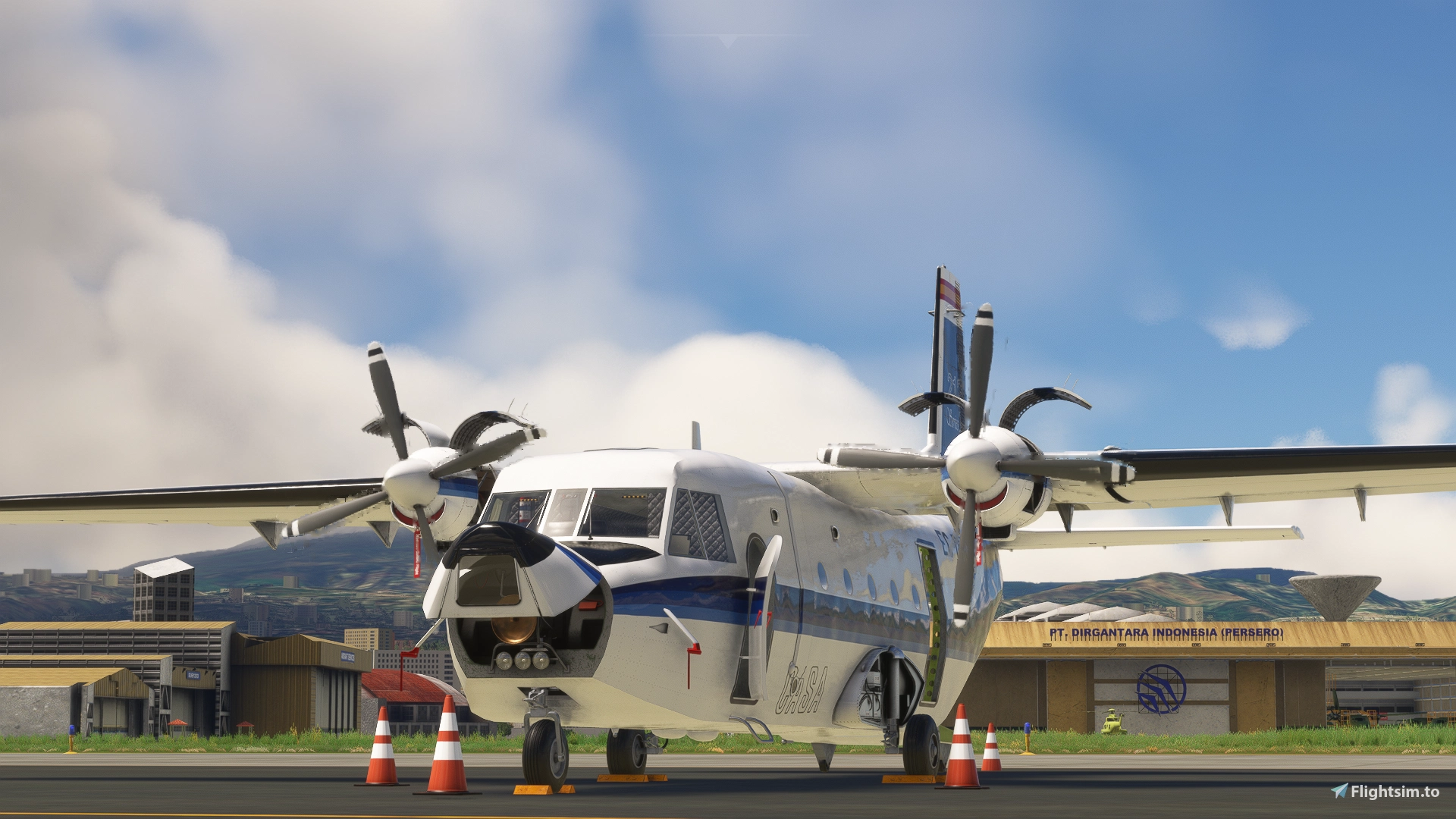
The CASA C-212 Aviocar is a pretty unusual aircraft. Originally designed as a rugged utility aircraft, the C-212 was built around a simple idea: it needed to be able to operate where larger aircraft couldn't. With its high-wing configuration, fixed landing gear, low-pressure tires, and rear cargo ramp, the Aviocar was designed for everything from short and unprepared runways to military transport and general utility operations.
We wanted to bring that character into Microsoft Flight Simulator. The result is our C212-200, developed for both Microsoft Flight Simulator 2020 and Microsoft Flight Simulator 2024. Rather than treating the aircraft as simply another turboprop to fly around in, we've approached it as a complete simulation of the aircraft and its systems.
From the beginning, one of our priorities was making the C212 feel like an actual aircraft rather than a collection of visual models and simulated switches.
The cockpit has been modeled down to the individual switch level, with the various panels, instruments, and controls recreated around the real aircraft. Engine instrumentation covers torque, RPM, EGT, oil and hydraulic parameters for both engines, while the overhead panel provides access to the aircraft's electrical, hydraulic and fuel systems.
And importantly, these aren't simply switches that move because they look good. The systems behind them are designed to actually function and interact with one another.
The avionics can also be configured to represent different real-world C212 installations. Depending on the selected configuration, the aircraft can feature the classic HZ444 or EFD84 ADI/HSI, alongside different navigation equipment including GTN, GNS and KLN 90B units. A functional Bendix weather radar is also included.
One of the biggest areas of focus for the C212 has been its systems.
The electrical, hydraulic, fuel, avionics, and flight-control systems have all been developed around the real aircraft's operating logic.
The C212-200 is powered by the Garrett/AlliedSignal TPE331-10R, and the engine has received its own dedicated simulation.
The TPE331 is quite different from many of the turboprops commonly found in flight simulators. Its fixed-shaft architecture, direct Beta operation, and constant-speed propeller give it a distinct operating philosophy, and we've built the simulation around those characteristics. Starting procedures, engine response, propeller control, feathering, and power management are all modeled accordingly.
For users who want to take the simulation even further, the C212 also features an optional extended engine simulation. Engines can develop their own history over time, including wear, oil consumption, contamination, individual engine variations, and maintenance effects.
The C212-200 is also only the beginning of the C212 family within Project MAX, with the -100 already entering the development phase.
Comments (5)
pantalones cortos Trescientos sesenta
It looks almost like a Shorts 360.
Excellent news! This is a long-awaited add-on.
The skyvan is one of my all time favorites! I can't wait to see where this project goes.
I will await and donate for this