


Microsoft and Asobo’s developer livestreams are where you hear about upcoming content, and also where the team answers for whatever went wrong in recent months. The last stream of 2026 did both. It ran live on Twitch on November 18, 2026, for about three hours. The usual panel was there: Jörg Neumann (Head of Microsoft Flight Simulator), Sebastian Wloch (Asobo CEO) and Martial Bossard (Executive Producer). Matt Nischan from Working Title joined them to present the Embraer Praetor 600. The stream covered a new World Update, the 2027 roadmap, a post-mortem of the recent flight model problems and a long list of smaller updates.
World Update 24: South Africa
The biggest scenery news is World Update 24. It focuses on South Africa and is scheduled for Q1 2027. It will include 10 photogrammetry areas from Vexcel, 3 handcrafted airports by Gaya Simulations and 44 points of interest, plus new activities for pilots. The three airports are King Shaka International (FALE) near Durban, Kruger Mpumalanga International (FKAN) and George Airport (FAGG). One caveat: the photogrammetry previews in the stream were not captured inside the simulator, so the final in-sim result may look different.
Local Legend 27 also comes from South Africa. iniBuilds is building the Paramount Aerospace Mwari, a South African surveillance and light-attack aircraft designed to be cheap to operate, which fills both drone-style and ground-attack roles. The demo showed its glass cockpit, HOTAS controls, walkaround equipment, a rear operator station and night-vision goggles.
Scenery Beyond South Africa
The team also talked about other regions. Phoenix is getting an update based on 2023 data. New data for Seattle is available but still needs processing. A Czech Republic and Slovakia update is possible at some point, and Vexcel may fly South America again, which would allow new photogrammetry there. Shorelines and “lumpy water” should improve, mainly in the US and Western Europe, because data collectors fly other regions less often. Antarctica is not planned for now, though Microsoft will look for data if any exists.
Neumann also explained some of the limits on new scenery. The sim currently doesn’t receive Bing imagery updates, because Bing changed its imagery partnership and that created new licensing problems. He added that team time is limited, that real-world data is hard to collect and sometimes requires commissioned flights, and that even high-quality data can need around 500 hours of hand editing.
The 2027 Roadmap
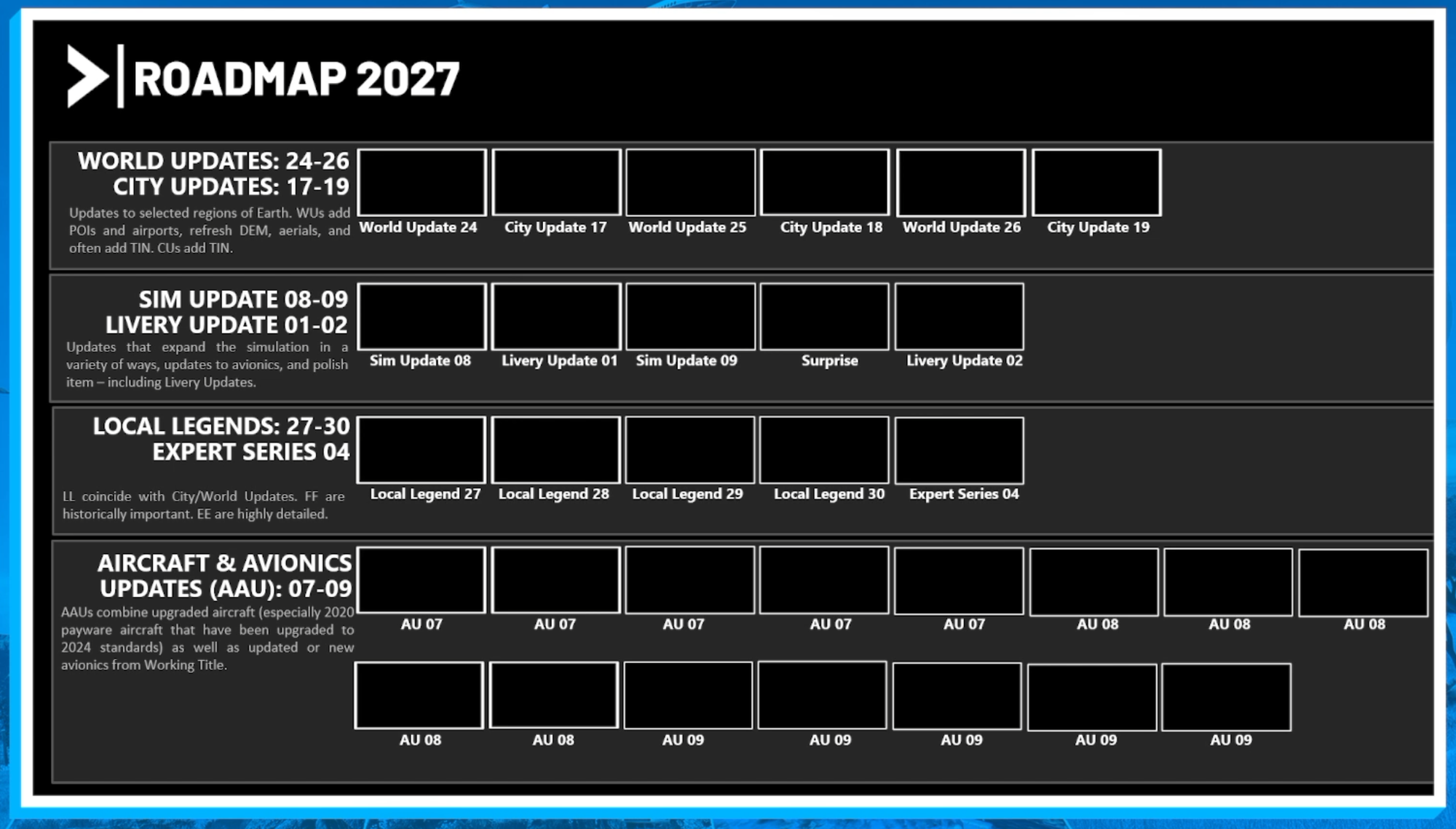
The 2027 roadmap includes two Sim Updates, two Livery Updates, three World Updates, three City Updates, four Local Legend aircraft, one new Expert Series aircraft and several Aircraft & Avionics Updates that bring Microsoft’s remaining payware aircraft up to MSFS 2024 standard. Neumann also promised a “very big” surprise after Sim Update 9, but gave no details. He said the low number of Sim Updates is a lesson from the regressions in MSFS 2024 updates over the past year. With only two Sim Updates planned, the team is choosing stability over a fast release pace.
What Went Wrong With SU7, and What SU8 Brings
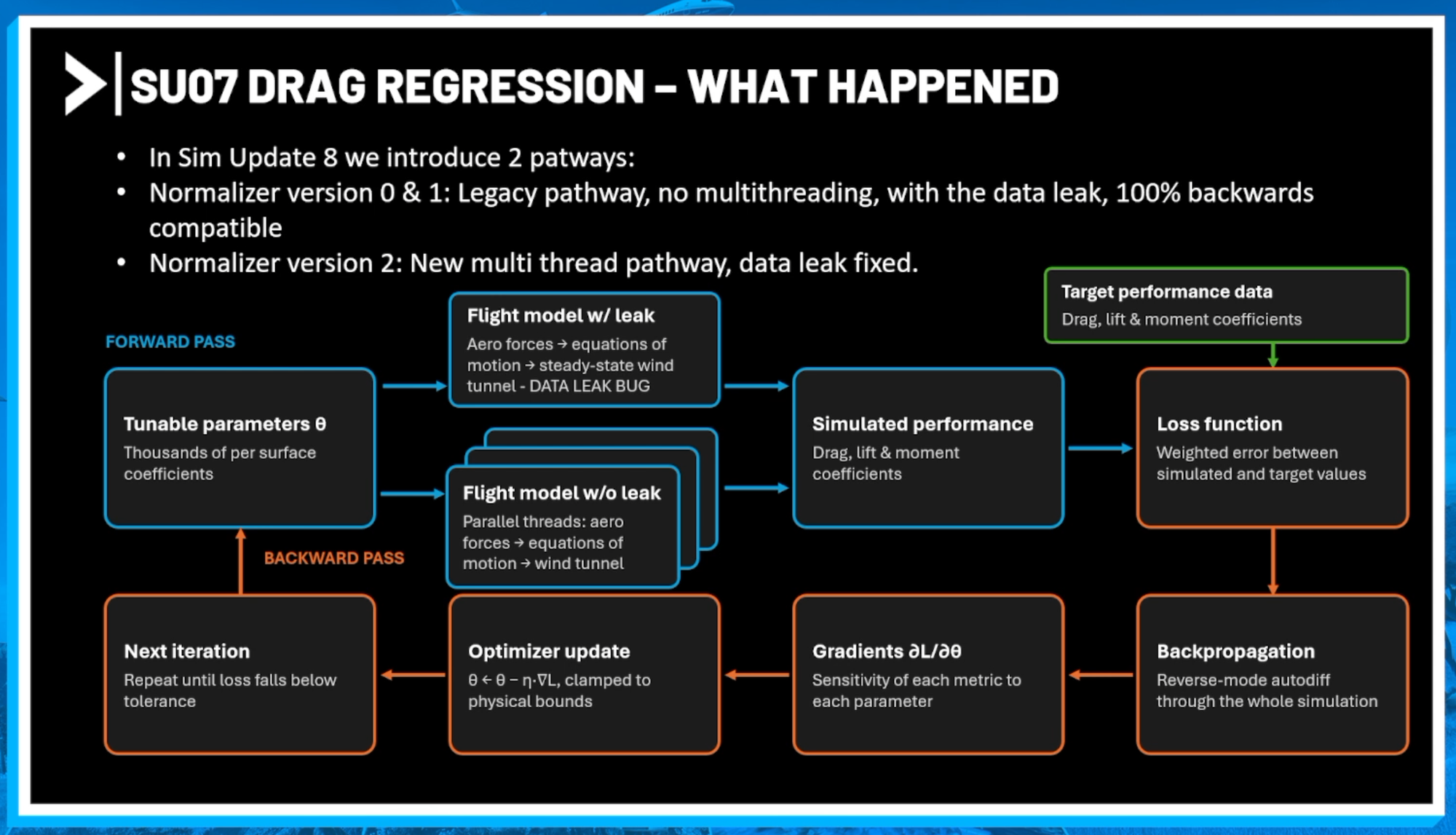
Much of the stream dealt with the drag problems that hit many aircraft after Sim Update 7. The cause was “normalization”, an automated process that tunes an aircraft’s aerodynamic surfaces to meet performance targets. A bug several years old let a wing-turbulence effect leak into the rest of the aircraft, and developers had been compensating for it without knowing. SU6 then made normalization multithreaded to reduce loading stalls, which made the bug’s effects inconsistent on some aircraft. SU7 fixed the bug, but that broke aircraft that had been tuned around it. SU7.2 then went back to the SU5 normalization behaviour. Wloch openly said he wrote the line of code responsible. The issue appeared on the last day of the SU7 beta, and the team decided not to delay the release because it believed only a limited number of aircraft were affected.
Sim Update 8 should let developers fix this properly. Developers can opt in to the corrected normalization, which may mean retuning their flight models. SU8 also adds vorticity confinement to the helicopter CFD model and a new debug interface where developers can change CFD parameters in real time. Ground handling is part of this too. Wloch said the sim already has an advanced wheel-contact model, better ground friction and tire and gear elasticity, but many aircraft don’t use them. A diagnostic tool will show developers which features an aircraft uses and how to turn on the others.
Weather Gets Attention
Weather was one of the community’s main complaints. Simmers have reported thin cloud coverage, missing cloud types, weak thunderstorms and cloud tops that seem capped at around 20,000 ft. The team said many of these effects already exist and appear in presets, but the live weather data, or the way it is converted, may be the limiting factor. Wloch said the cloud engine can draw clouds up to about 40,000 ft and promised to investigate. Neumann agreed this needs action and said weather is now recognised as a priority for users. Better snow coverage with live weather is also being looked at. No complete fix has been named yet, so this is a stated priority, not a scheduled feature.
On damage modelling, Neumann said the team had asked aircraft manufacturers about it, and they overwhelmingly declined.
Aircraft Updates: Praetor 600, A330, An-225
Working Title’s Embraer Praetor 600 is now set for December 8, 2026. It was moved slightly so it doesn’t launch at the same time as iniBuilds’ Global 6000, and Neumann said the date is still tentative. Nischan showed a cold and dark startup. The engines and APU are simulated with physics-based calculations, and the hydraulics and pneumatics are physics-based too.
The Microsoft/iniBuilds A330 is getting a major update covering the A330-300, A330-200 and A330 P2F. It adds Lido and Navigraph charts in the EFB, optional automation such as 2x and 4x time compression and pause at top of descent, headset-style audio filtering, more cockpit sounds and hardware support for popular peripheral makers. No release date was given. A native MSFS 2024 version of the An-225 is planned for early 2027. Licensing talks for bringing back the Dune Ornithopter are ongoing. The community team is also collecting feedback on the ATR, though no updates have been confirmed.
Livery Update 1 has been moved into 2027, probably to launch with SU8, because of the licensing workload. It covers AI traffic and applicable flyable aircraft on PC, Xbox and PS5. New Korean Air liveries are among those included.
Marketplace, PS5 and MSFS 2020
The first three rows of the Marketplace are now curated, after complaints that it focused too heavily on new releases. Gifting launches on November 19, 2026, so you can buy products for friends. Microsoft and Asobo admitted that the PS5 release process has had problems, especially the rollout of the developer analysis tool, and said they are working on better WASM content processing for PS5.
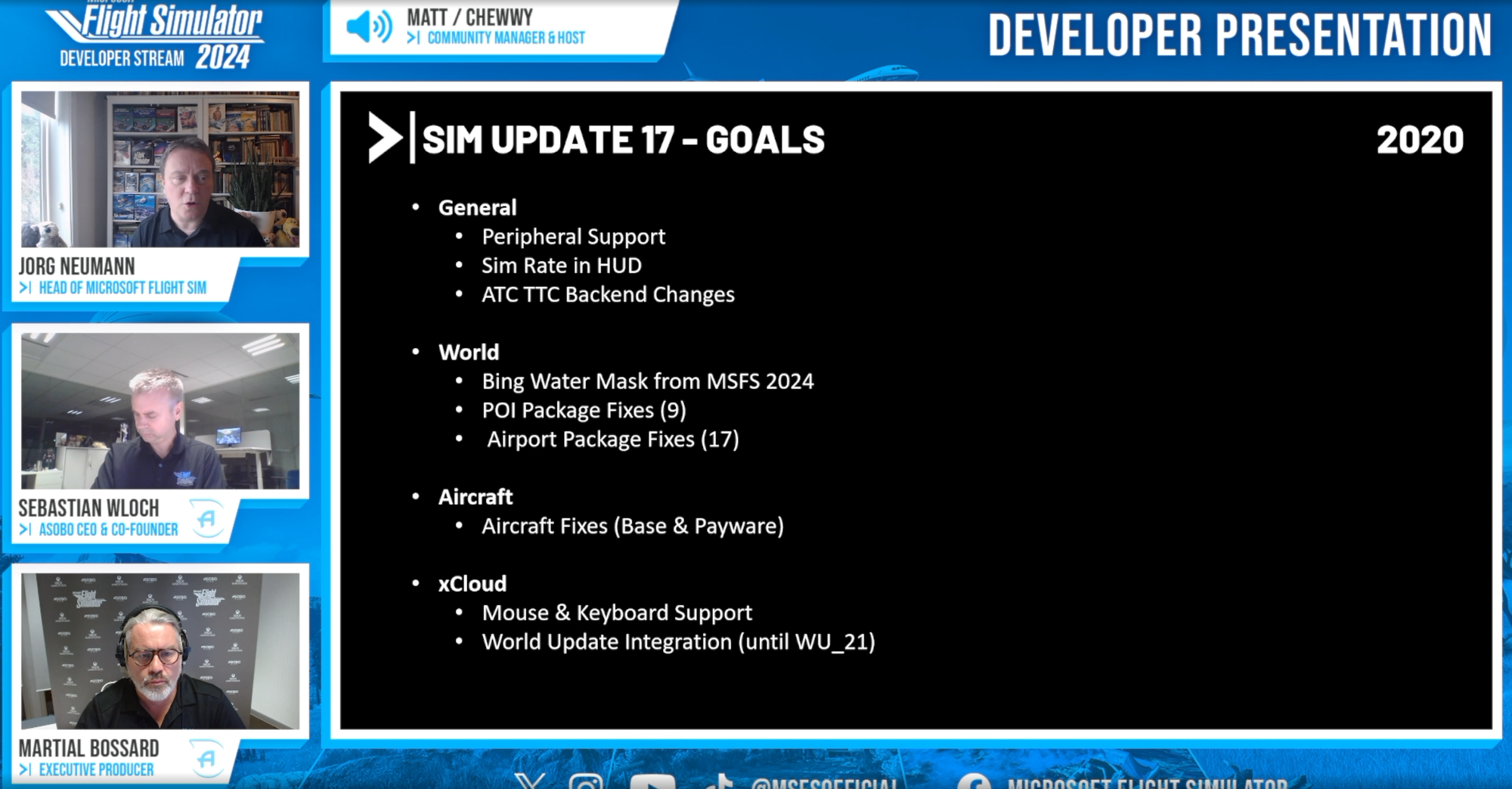
MSFS 2020 hasn’t been dropped. Sim Update 17 adds more peripheral support, a sim-rate indicator in the HUD, ATC backend changes, water-mask improvements from MSFS 2024 and mouse and keyboard support on Xbox Cloud Gaming. The beta may have a stability regression. If stability is confirmed, the update could arrive within a couple of weeks. Neumann asked MSFS 2020 players to join the beta, because the test group is small.
Outlook
Neumann said October was the franchise’s strongest month ever by participation, despite high hardware prices and recent software problems. The stream showed a team that is more open about its mistakes and plans fewer, larger updates for 2027. In the near term, you have the Praetor 600 in December and World Update 24 early next year. The next Q&A is expected in January. Until then, Flightsim.to will keep reporting on these updates and the freeware scenery that usually follows a new World Update.