
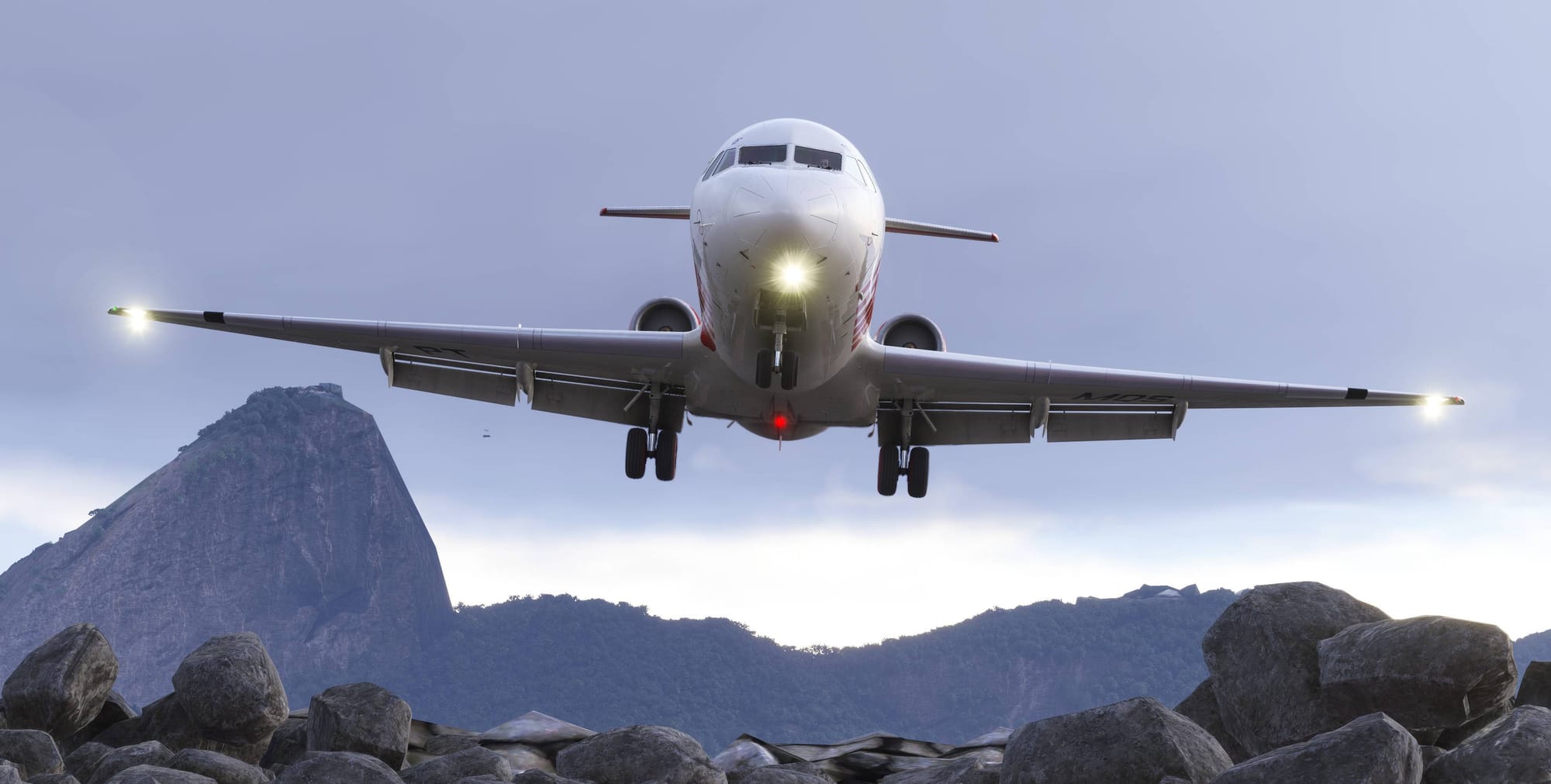
After years of anticipation, one of the most-watched development projects in the Microsoft Flight Simulator community has finally crossed the finish line. Just Flight officially released the F70 Professional and F100 Professional on June 25, 2026 — a pair of high-fidelity simulations of the iconic Dutch regional jets that, until now, had been notably absent from the study-level aircraft shelf in Microsoft Flight Simulator. You can already find liveries for the 🎨 Just Flight F70 Professional and for the 🎨 Just Flight F100 Professional on Flightsim.to.
The Fokker F100 and its shorter sibling, the F70, hold a respected place in commercial aviation history. As an evolution of the F28 turbojet regional airliner series, the F70 and F100 were developed into stretched and modernised versions targeted at the crowded, yet lucrative, modern regional jet market. The F100 first flew in 1986 and entered airline service in 1988, while the F70 — with a fuselage shorter by 4.62 metres — followed in 1993. Both types found homes with a diverse range of operators worldwide, from KLM Cityhopper, Austrian Airlines, American, and QantasLink to dozens of other carriers, with a handful still in active service today, including Alliance Airlines in Australia.
A Development Journey That Spans Half a Decade
Work on the project goes back to 2022, when the first art assets were built for FSX and Prepar3D, before the team moved fully to Microsoft Flight Simulator in late 2023. The development road wasn't without its challenges. The primary reason for the extended timeline came down to one particularly complex system: Just Flight scrapped its first vertical navigation implementation and rebuilt it from scratch — the first time the studio has developed a fully autopilot-coupled VNAV system. That level of commitment to getting it right reflects the overall ambition of the project, which Just Flight has described as its most complex airliner release to date.
The VNAV system sits inside the AFCAS — the Automatic Flight Control and Augmentation System — which is the Fokker's autopilot and flight director architecture. Its Profile mode handles vertical navigation along a filed route, and Just Flight says the aircraft can now fly in Profile mode from 35 feet after takeoff down to approach minimums, holding to altitude and speed constraints and raising alerts on the PFD and CDU whenever a descent path is too steep or a flight plan discontinuity is detected.
Systems Depth
Both Fokkers feature complex, fully custom-coded systems based on real-world FCOMs, including electrical, hydraulic, fuel, and pressurisation systems, along with a comprehensive avionics suite comprising the AFCAS, Automatic Thrust System, independent flight management computers, dual inertial navigation systems, an electronic flight instrument system, and multifunction display units.
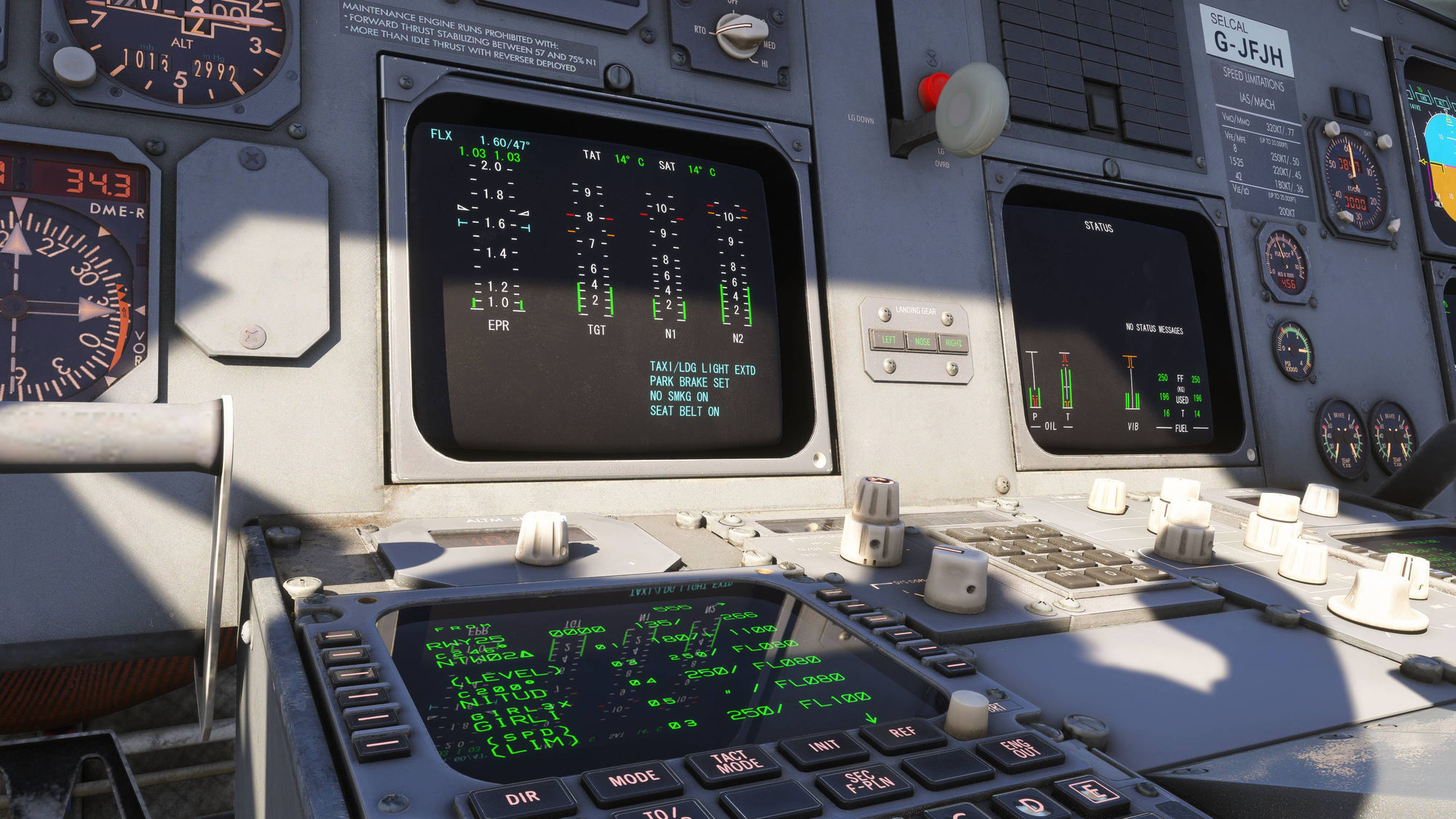
The dual FMS CDUs are independently simulated, meaning the entire flight can be managed from either seat. A cost index system — described by Just Flight as new to one of their aircraft — is included alongside place-bearing-distance and custom waypoint creation, nav aid remote tuning, and selectable IRS alignment that ranges from a couple of minutes near the equator to around fifteen minutes at high-latitude airports. A fast-alignment toggle is available on the EFB for those who'd rather skip that wait.
The real-world idiosyncrasies of the Fokker family have also been faithfully reproduced. Both types are certified for flap-zero takeoffs — the preferred setting when runway length allows — which is a departure from what most airliner pilots in MSFS are used to. The speed brake has only two positions, in and out, and is entirely separate from the lift dumpers. The gear retracts in just nine seconds but takes thirty-two to extend, a deliberate engineering decision to prevent sudden pitch changes on approach. A heavy F100 in warm conditions can take more than forty minutes to reach cruise altitude, turning short European hops into genuinely procedural flights.
Variants, Liveries, and a Brand-New Livery Manager
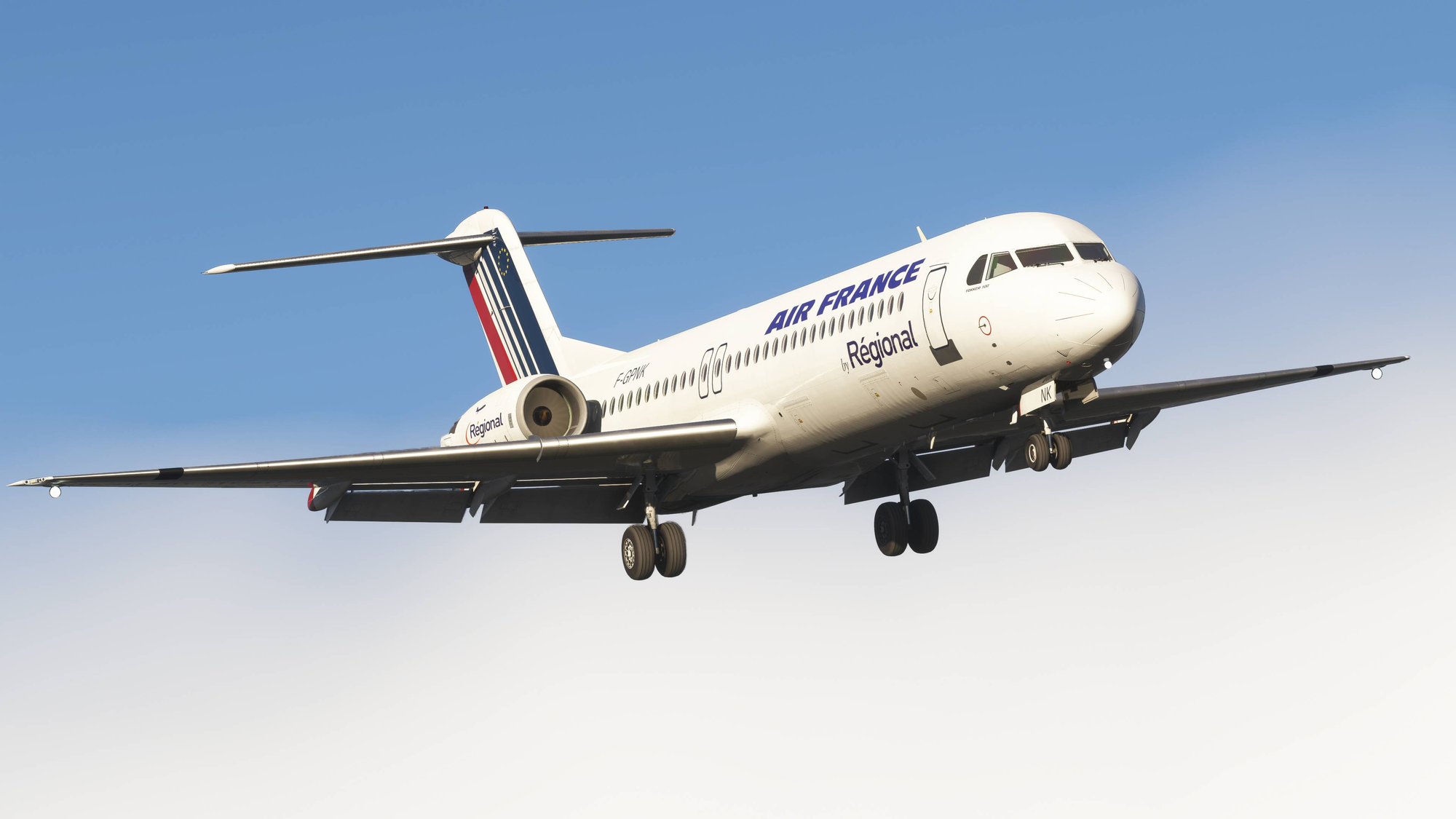
The aircraft are sold in three editions: the F70 on its own covering one variant, the F100 covering four variants, or both together in a bundle covering five variants. Every purchase includes native builds for both MSFS 2020 and MSFS 2024. The four F100 configurations each carry their own unique door layouts, cabin designs, and flight models, accurately reflecting the real-world diversity of how the type was operated. Only one F70 variant is included, which mirrors the single configuration actually used by airlines. Alongside the aircraft themselves, Just Flight introduced a dedicated livery manager application, giving you more flexibility to download paint schemes in either 4K or 8K resolution for both simulator versions. This also allows Just Flight to push livery updates and upgrades more efficiently. The F70 ships with 11 liveries and the F100 with 18, totalling 29 across both aircraft.
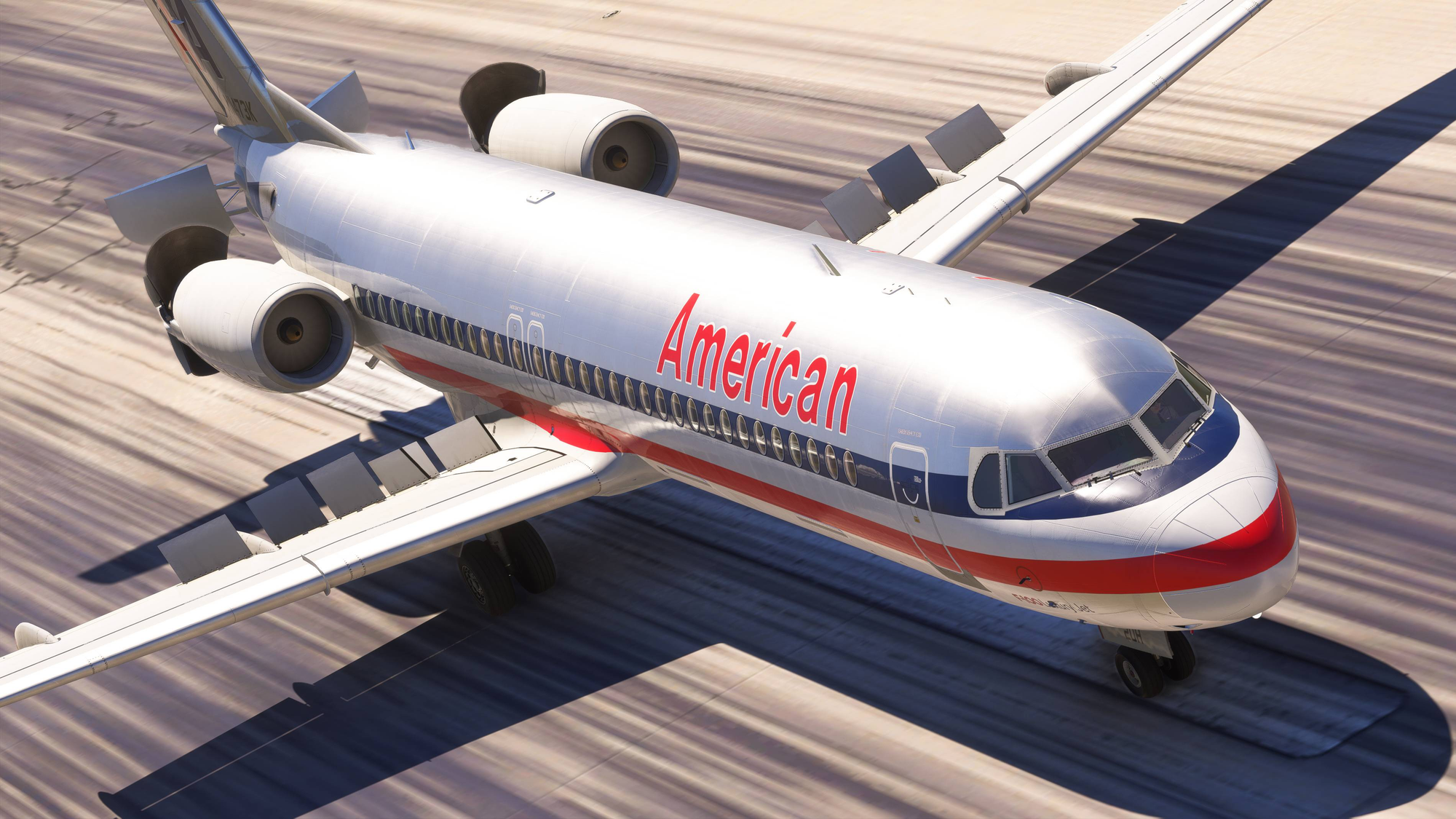
The cabin receives an equally thorough treatment. Just Flight produced more than 25 cabin variants, each livery shipping with its own custom cabin textures, alongside an advanced galley simulation, fully interactive doors, Auto Cabin Crew logic, an interphone, and a digital music player with announcement and music modes. The passenger cabin is fully modelled and can be disabled for those looking to manage performance. On the audio side, the soundscape was created using Audiokinetic's Wwise engine, recorded directly from real F70 and F100 aircraft, with hundreds of individual recordings made during dedicated sound sessions on the actual types. Just Flight has described it as the most accomplished sound work they've produced to date.
Pricing and Where to Buy
The F70 Professional and F100 Professional are each available individually for USD $69.99 / EUR €61.54 / GBP £53.02. For those wanting both, the F70 & F100 Professional Bundle brings the pair together at USD $84.99 / EUR €71.99 / GBP £59.99 — a saving of roughly $55 compared to purchasing them separately. Initially, the aircraft are exclusively available through JustFlight.com, with third-party retailers and the in-sim marketplaces to follow at a later date.
3 months ago